
Putting Thought Into Action: Why Smart Leaders Still Get Stuck
By Dr. Don W. Hooper, Ph.D., CTL® | Center for Quality Leadership®
KEY TAKEAWAYS
The real leadership problem isn't a shortage of good thinking — it's the gap between knowing something and acting on it.
Stanford researchers Jeffrey Pfeffer and Robert Sutton named this the “knowing-doing gap” and found it undermines even the most capable organizations.
A global executive survey cited by Harvard Business Review found roughly two-thirds of senior leaders don't believe their own organization has the capability to execute the strategy it already has.
Most execution frameworks pick up after a decision has already been made. They don't address why the decision stalled in the first place.
Power Thinking™ works at that earlier moment — the point where a leader has enough information to decide but hasn't yet trusted it.
I've Watched This Happen for Fifty Years
I spent over twenty-five years as a Texas school superintendent, and I've spent decades since then working alongside senior leaders in education, law, medicine, government, and corporate life. I've sat in enough boardrooms and cabinet meetings to know one thing for certain: the people at the table are almost never the problem. They're smart. They're experienced. They've read the books and sat through the conferences.
What I keep watching happen is different. A leadership team spends three hours building real alignment on a direction. Everyone nods. Everyone leaves the room believing something was decided. Six weeks later, the same issue is back on the agenda, and nobody can quite explain how the plan quietly drifted, or why the team is right back where it started.
That isn't a knowledge problem. Every person in that room already knew what needed to happen. It's an action problem — and it's the single most common failure I've seen in three decades of leadership work.

The Problem Isn't What You Know
Stanford researchers Jeffrey Pfeffer and Robert Sutton studied this exact pattern across dozens of organizations and wrote about it in their book, The Knowing-Doing Gap: How Smart Companies Turn Knowledge Into Action. Their finding still holds up: an organization's real strength isn't measured by what it knows. It's measured by what it does with what it knows.
The numbers back this up. A global survey of senior executives, cited in Harvard Business Review's research on strategy execution, found that more than half didn't believe their company had a winning strategy in the first place — and roughly two-thirds said their organization lacked the capability to execute the strategy it already had. Two-thirds. That's not a strategy problem. That's a thinking-into-action problem, and it's happening inside organizations that are, by every other measure, full of capable people.
I see the same pattern show up in individual leaders, not just organizations. A superintendent, a hospital administrator, a partner at a firm — someone with thirty years of hard-won judgment — starts second-guessing calls they would have made instantly a decade earlier. The information hasn't gotten harder to find. The decisions have gotten heavier, and something in how they're processing that weight has started to slow them down.
Most Execution Advice Starts Too Late
There's no shortage of good material on execution. Larry Bossidy's book Execution: The Discipline of Getting Things Done makes the case that leaders should treat execution as a core discipline, not something to hand off to others. The 4 Disciplines of Execution, from Chris McChesney, Sean Covey, and Jim Huling, gives teams a system for narrowing focus and tracking the measures that actually move a goal forward. Both are genuinely useful, and I recommend them.
But notice where they start. They start after the decision has already been made — after the goal is set, after the priority is chosen. What none of them address is the moment right before that: the point where a leader is sitting with 50 or 60 percent of the information they'd like to have, and has to decide whether that's enough to act on.
That moment is where most stalling actually happens. Not in the follow-through. In the decision itself, before follow-through is even possible.
The Missing Layer: What Happens Before the Decision
This is exactly where Power Thinking™ operates, and it's the piece I built the framework around after decades of watching leaders get stuck at this precise point rather than downstream of it.
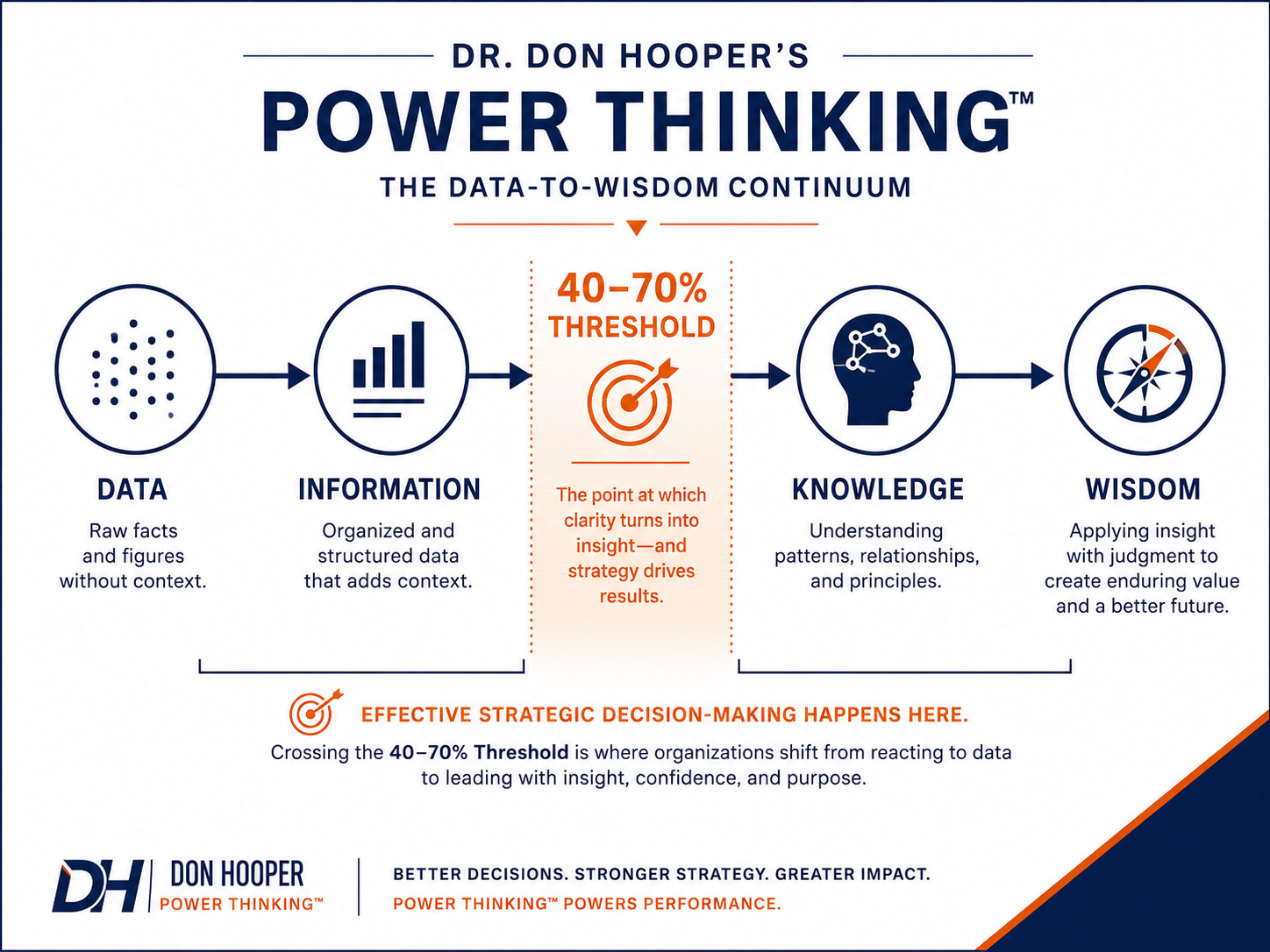
Power Thinking™ maps what I call the data-to-wisdom continuum — the actual sequence a mind moves through between receiving raw information and arriving at sound judgment. Most leaders were never taught to recognize where they are on that continuum in the moment, so they either freeze waiting for data that will never fully arrive, or they swing the other way and decide too fast on instinct alone.
One piece of that model is what I call the 40-to-70 percent information threshold: the idea, well supported by decision research, that waiting for complete information before acting isn't caution — it's a different kind of failure. Somewhere between 40 and 70 percent of the information a leader would ideally want is usually the real window for a sound decision. Below that, a leader is genuinely guessing. Above that, the additional research rarely changes the outcome — it just delays it, while the cost of delay keeps accumulating.
The other piece is understanding quantum versus binary thinking: recognizing when a problem actually has a single right answer to be found through more analysis, and when it instead has several reasonably good paths that all require the same thing — a leader willing to commit and adjust, rather than one more round of study.
Three Ways to Start Putting Thought Into Action This Week
Name your threshold before you start gathering information. Decide in advance what “enough” looks like for the decision in front of you — a number of data points, a number of people consulted, a deadline. Without a defined threshold, more research always feels like the responsible choice, even when it's really delaying wearing a responsible costume.
Separate the decision from the doubt. Doubt about whether you're ready is a feeling, not new information. Once you've hit your threshold, treat further hesitation as a signal to check your own reasoning, not a signal to reopen the research.
Close the loop out loud. Alignment in a meeting is not the same thing as a decision. Before the room disperses, say what was actually decided, who owns it, and by when it will be visible — in those words, not implied ones. This single habit eliminates most of the quiet drift I described earlier.
Where This Leads
None of this is about thinking less. It's about knowing exactly when thinking has done its job and action needs to take over — and building the confidence to make that call under real pressure, with real stakes, without waiting for certainty that was never going to arrive.
That's the exact skill I teach inside the Power Thinking™ workshop, and it's the foundation of everything that follows it: the Critical Skills Mini-Course, the Power Thinking™ Mastermind, and ultimately the Certified Thought Leader® credentialing process. If the pattern I've described sounds familiar — a capable team, good ideas, and a persistent gap between what gets decided and what actually happens — start with the free 20-minute Power Thinking™ workshop at power-thinker.net/freeworkshop-page. It's built to give you one usable model you can apply to a real decision you're facing right now.
Dr. Don W. Hooper, Ph.D., CTL®, is President and CEO of the Center for Quality Leadership® and author of Power Thinking: Discovering the Unknown by Unlocking Your Brain.
