AI Won't Replace Managers. It Will Replace Managers Who Stop Thinking.
KEY TAKEAWAYS
The headline "AI is replacing managers" is misleading — the data points to one specific kind of manager who is at risk.
Gartner predicts 20% of organizations will eliminate over half of their current middle management roles using AI through 2026.
Only 8% of HR leaders believe their managers have the skills to use AI effectively today.
The leaders' AI cannot replace are those who already operate at the top of the data-to-wisdom continuum.
Power Thinking™ is the trainable system I built to separate the managers AI will keep from the managers AI will replace.
Every week, I see another headline declaring that AI is coming for your job. The story is usually the same. Machines are getting smarter, executives are getting nervous, and somewhere in the middle, a manager is about to be replaced by a chatbot.
I want to tell you the story is wrong.
In over forty-five years of leadership work — as a school superintendent, as President of the American Association of School Administrators, and today in my work with executives and government leaders through the Center for Quality Leadership — I have watched these waves before. New technology arrives. People panic. Then the data comes in, and the data is always sharper than the headline.
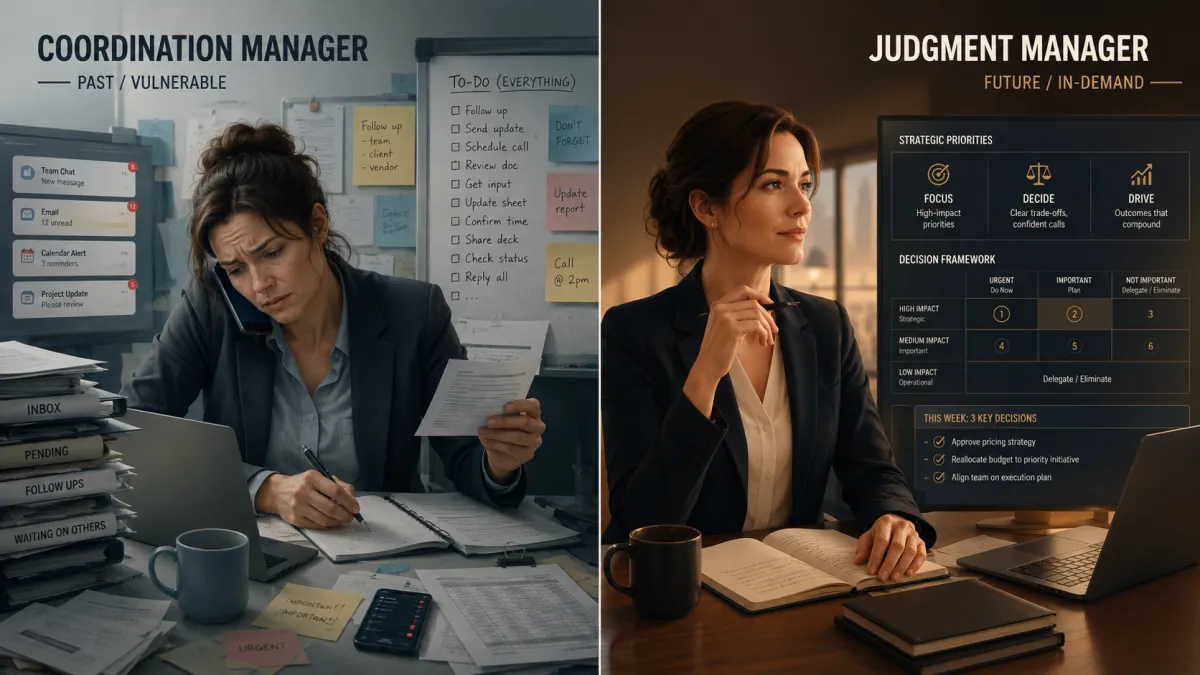
Here is the sharper truth. AI is not replacing managers as a category. AI is replacing one specific kind of manager — the kind who has built a career out of forwarding reports, summarizing updates, and translating strategy downward. If that describes your day, the algorithm is already underbidding you. And it will keep underbidding you until you change what makes you valuable.
This is the moment to decide who decides — you, or the machine.
The Headline Everyone Is Reading Is Wrong
Gartner's research is direct: through 2026, 20% of organizations will use AI to flatten their structures and eliminate more than half of their current middle-management positions. That number is staggering. It is also incomplete.
Look at what is happening on the other side. Research from IESE Business School analyzed 375 million U.S. job postings between 2010 and 2022 and found that companies adopting AI are hiring more managers, not fewer. The kind of manager has shifted. Coordination is being automated. Judgment is being elevated.
Two stories are unfolding at once. One kind of manager is being cut. Another is being recruited at a premium. The question I want you to sit with is which one you are.
AI Owns Efficiency. You Must Own Effectiveness.
McKinsey Global Institute reports that generative AI could automate activities accounting for 60 to 70 percent of the time today's workers spend on the job.
When leaders read that number, most panic. The Power Thinkers I work with reframe it.
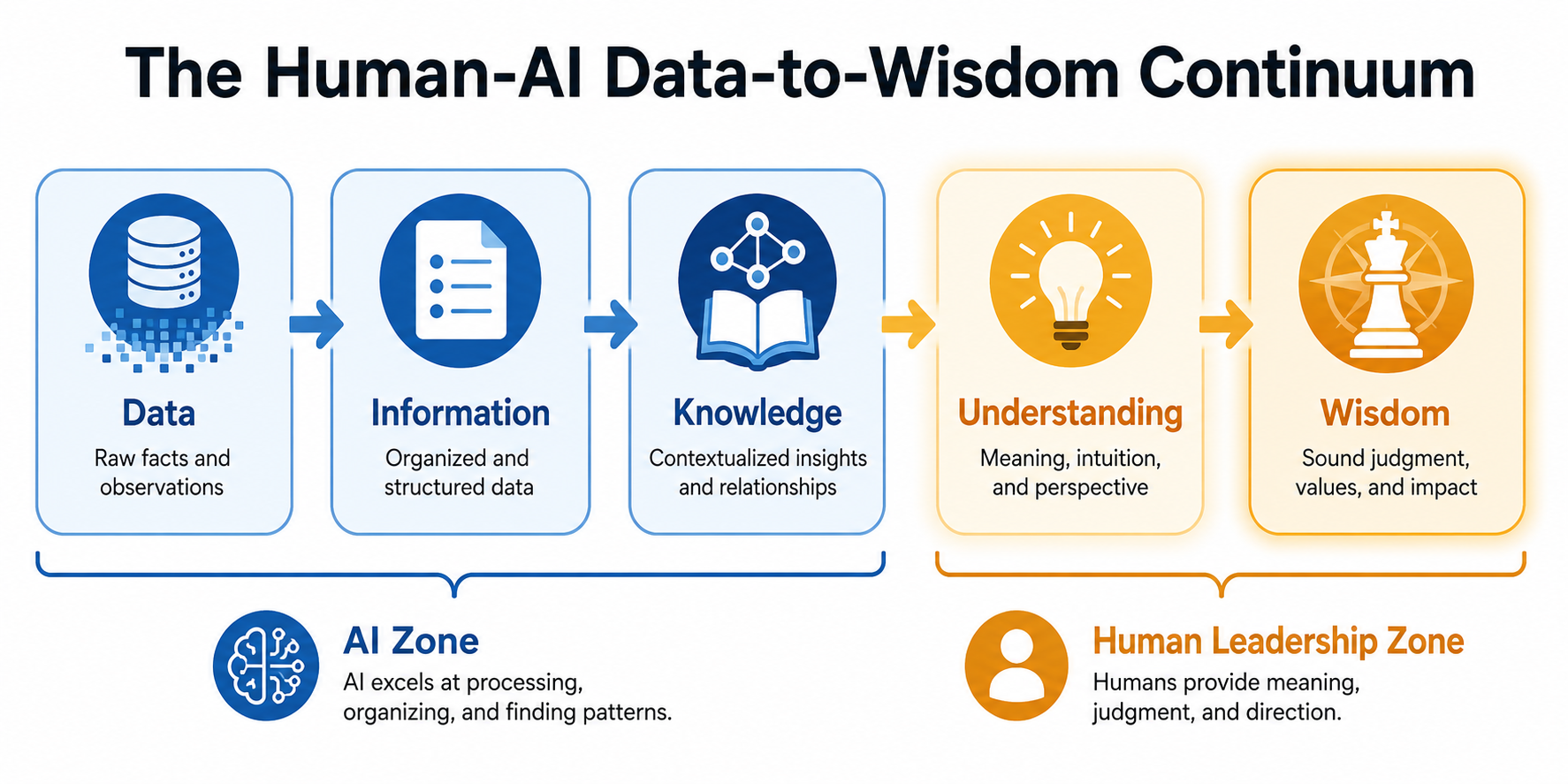
In my book Power Thinking™, I introduced what I call the data-to-wisdom continuum. Data becomes information. Information becomes knowledge. Knowledge becomes understanding. Understanding becomes wisdom. AI is exceptional at the first three steps. It is fast, more accurate, and consistently rational. What it is not is intuitive, emotional, or culturally sensitive. It cannot imagine, anticipate, feel, or judge a changing situation the way you can.
Here is the principle I teach in every CTL® cohort: efficiency is doing things right. Effectiveness is doing the right thing. Excellence is both. AI handles efficiency now. Your job is to own effectiveness — and that is not a job AI is coming for.
Want the decision-making framework I teach executives, government leaders, and Fortune 500 cohorts? Join my free 20-minute workshop and walk away with a system you can use on Monday morning: power-thinker.net/freeworkshop-page
Model 5: The 40–70% Rule That Beats Algorithmic Hesitation
In my experience, most managers fall into one of two AI traps. The first is paralysis — waiting for AI to give you 100% certainty before you make the call. The second is abdication — rubber-stamping whatever the algorithm outputs without applying your own judgment.
Both end the same way. The manager becomes invisible to the decision.
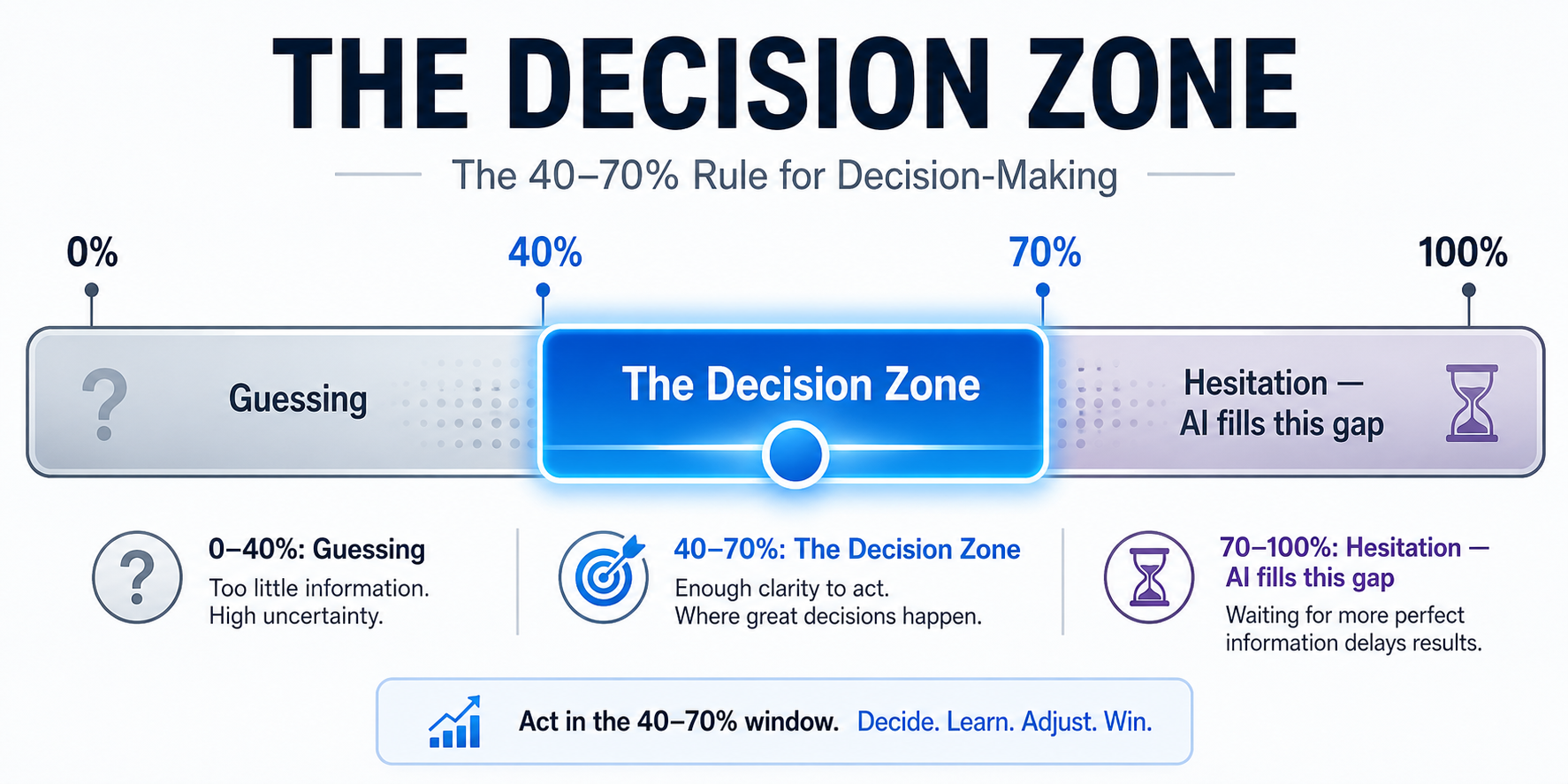
Power Thinking™ Model 5 is the answer I give my clients. Stay within 40% to 70% of the available information for a quick decision. Think fast, learn fast. Below 40% and you are guessing. Above 70% and you are hesitating — and hesitation is exactly the gap AI is built to fill.
I have watched this play out in boardrooms and superintendents' offices for decades. The Power Thinker decides at 40 to 70 percent, then iterates. The shortcut taker waits for the model to decide. Only one of those people is still leading in five years.
Build the Brain Behind the Decision
I wrote Power Thinking: Discovering the Unknown by Unlocking Your Brain to lay out the full neuroscience-based system — seven decision-making models, the data-to-wisdom continuum, and the brain training that makes you irreplaceable in an AI-first organization.
It became a #1 Amazon bestseller. Former U.S. Secretary of Education Rod Paige called it "a must-read for elite thinkers."
Get the book and start training the kind of thinking AI cannot copy: power-thinker.net
What John Femrite Taught Me About Decisions Under Uncertainty
I want to tell you about my friend John Femrite. John has been a real estate investor for decades. The market never gave him perfect information. Every deal carried risk. Every delay costs money. He could have waited for certainty. He didn't.
When I shared Power Thinking Discover the Unknown by Unlocking Your Brain with John, he read it and asked for follow-up discussions. He later told me the book "opened my mind to exercise different thinking strategies, thinking models, and deep thinking practices to minimize risks and maximize opportunities for success." He didn't need a perfect data set. He needed a trained brain that could move at the speed of opportunity.
That is the manager AI cannot replicate. Not because the manager has more information than the machine. Because the manager has built the muscle — neuroplasticity, judgment, wisdom — to decide when the machine cannot.
The leaders who survive the next 18 months are the ones who built that muscle before they needed it. The ones who didn't will be in the Gartner statistic, where only 8% of HR leaders today believe their managers have the skills to use AI effectively.

The Question Is No Longer Whether AI Will Change Management
The question I want you to walk away with is this: Is the kind of manager you have trained yourself to be the kind the next decade will pay for?
If your value is in forwarding reports and chasing updates, automation is already underbidding you. If your value is in clarity of vision, strategic problem-solving, and disciplined judgment under uncertainty, you are exactly the manager every AI-first organization is fighting to keep.
You don't get there by reading another headline. You get there by training the thinking.
Let me help you start. Take my free 20-minute workshop and learn the Power Thinking™ system I have used to help executives, government leaders, and ambitious professionals build the decision-making capability AI cannot replace: power-thinker.net/freeworkshop-page
