
Why Your Decision Framework Keeps Letting You Down
A framework is only as good as the thinking you bring to it. Here is how to fix the thinking.
By Dr. Don W. Hooper, Ph.D., CTL®
Key Takeaways
A decision framework holds whatever thinking you put into it, including your untested assumptions.
Data can only inform. It has to become information, knowledge and understanding before you can act with wisdom.
In the OODA Loop, Orient is the step where your assumptions shape what you see, and it is the step most leaders rush.
You cannot see your own blind spots, so better thinking needs honest feedback from other people.
When did a decision you made "by the book" still go wrong?
You listed the pros and cons. You ran the numbers. The process looked sound, and the result still disappointed you. Most leaders I talk with can name a decision like that.
Usually the trouble sits in the thinking that went into the framework, and that is the part you can train.
The Framework Is a Container
There is no shortage of decision models. The pros-and-cons list and the SWOT analysis are two that most leaders know well.
A framework is a container. It holds whatever you put into it. Put in untested assumptions, and you get a poor decision that looks well organized.
W. Edwards Deming said it plainly: "A bad system will beat a good person every time" (The W. Edwards Deming Institute). Leaders apply that line to their organizations. I ask them to apply it to their own minds. Your thinking is a system. If that system has a flaw, every framework you run through it carries the same flaw.
Data Can Only Inform
Many leaders describe themselves as data-driven. I would retire that phrase.
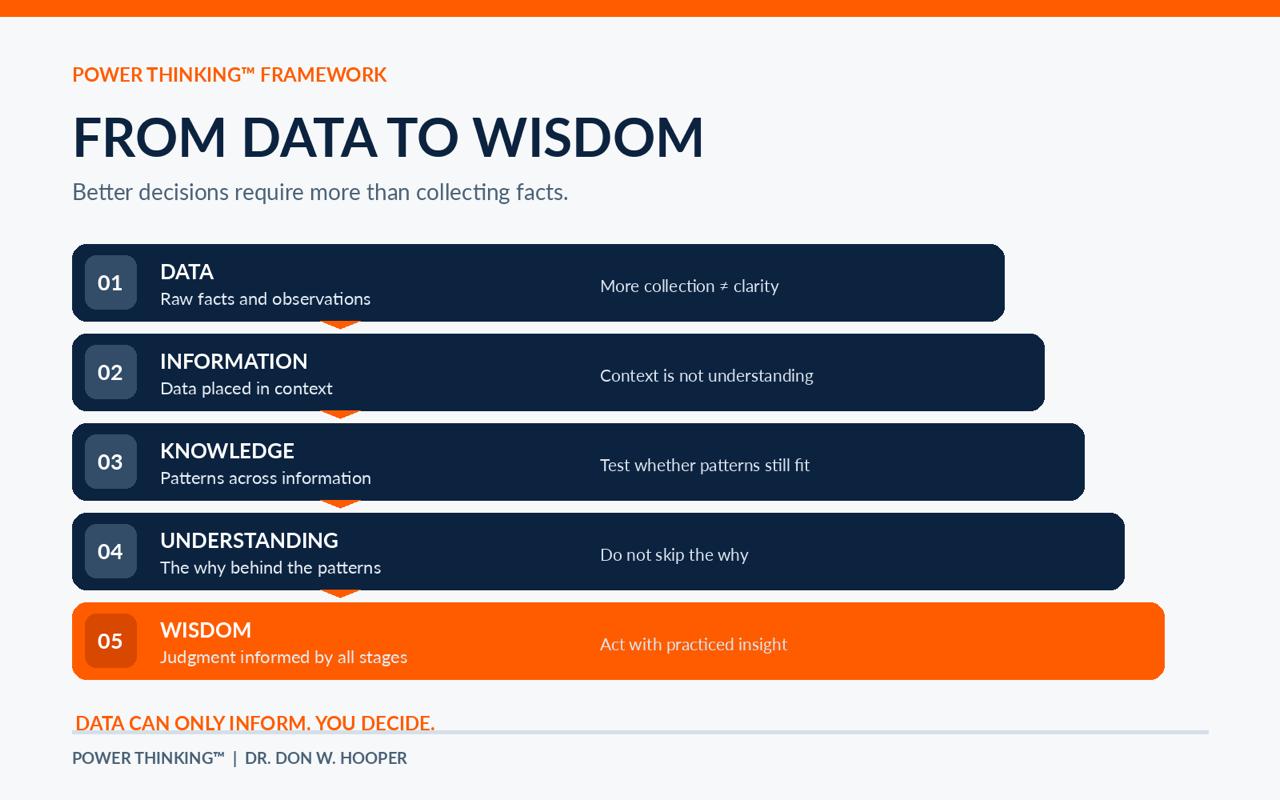
In my book, Power Thinking: Discovering the Unknown by Unlocking Your Brain, I describe a path from data to wisdom. Data becomes information when you put it in context. Information becomes knowledge when you see the patterns in it. Knowledge becomes understanding when you grasp the why behind those patterns. Then, and only then, can you act with wisdom.
Stage | What it is | Where leaders get stuck |
|---|---|---|
Data | Raw facts, numbers and observations | Collecting more without filtering it |
Information | Data placed in context | Mistaking context for understanding |
Knowledge | Patterns seen across the information | Applying old patterns to new problems |
Understanding | The why behind the patterns | Skipping it to move faster |
Wisdom | Judgment that draws on every stage | Rarely reached without practice |
Most leaders stop too early on that path. They gather more data and call it progress. More data does not make the decision. Data can only inform. You decide.
The Step Most Leaders Skip
When time is short, I teach the OODA Loop. It was developed by Colonel John Boyd, an Air Force fighter pilot and military strategist. In 2018, Air University Press published his briefing A Discourse on Winning and Losing as a book (Air University Press).
Boyd believed a pilot at a disadvantage could still win by out-thinking his opponent. In his view, agility could beat raw power. That idea holds for leaders as much as for pilots. The leader who makes sense of a situation faster and more clearly often wins, even with fewer resources.
The loop has four steps:
Observe: take in what is happening.
Orient: make sense of it. This is where your experience, training and assumptions go to work.
Decide: choose a course of action.
Act: carry it out, then observe again.
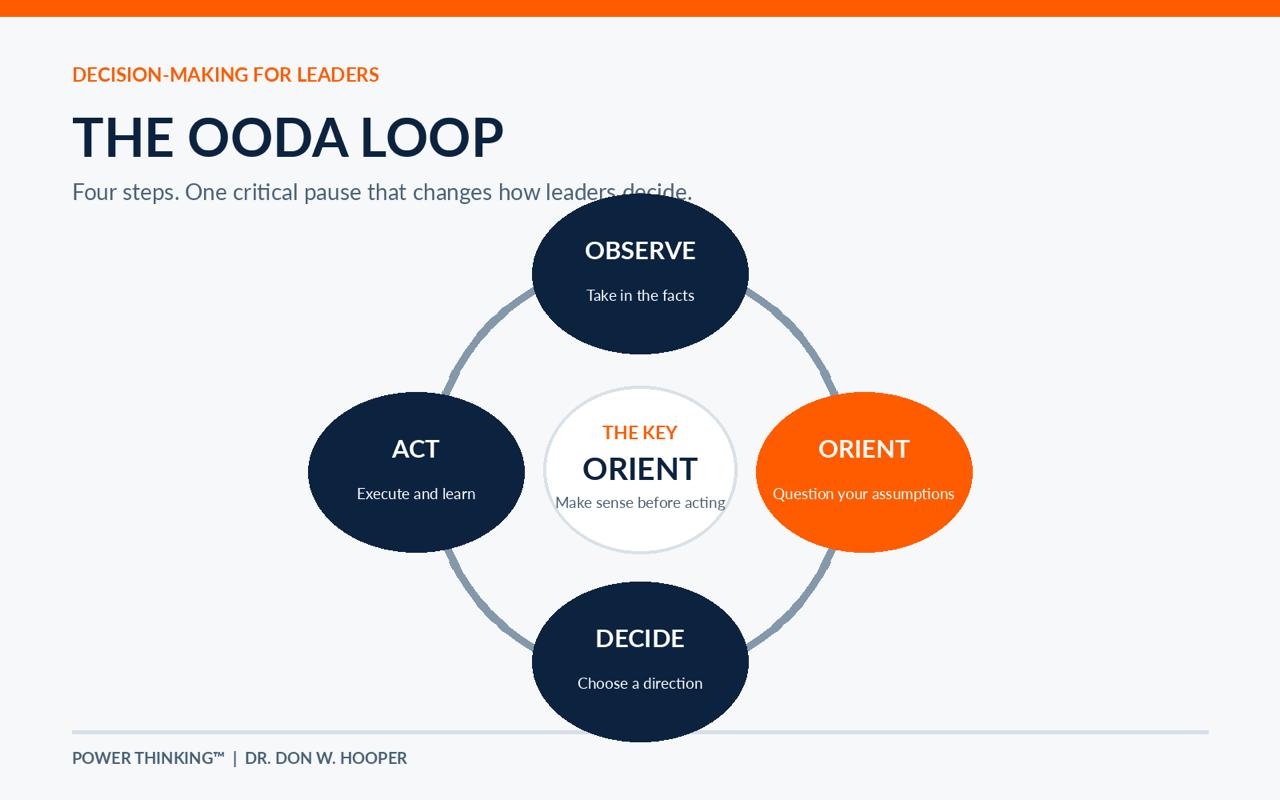
Here is what I see. Leaders under pressure jump from Observe straight to Decide. They see the numbers drop, and they act. They never stop to ask how they are reading the numbers.
To me, Orient is the step that matters most. Two leaders can look at the same facts and orient to them in opposite ways. One sees a crisis. The other sees an opening. The facts did not change. The orientation did.
How to Slow Down the Orient Step
This takes minutes. A few honest questions before you decide will do it.
1. Name the assumption. Ask yourself, "What am I assuming here that I have not checked?" Write it down. An assumption on paper is much easier to test than one in your head.
2. Try the opposite. Ask, "What would have to be true for the opposite decision to be right?" I call this inversion thinking. It puts a spotlight on the errors and roadblocks you would otherwise miss.
3. Borrow another mind's eye. Warren Buffett looks at the world with an investor's eye. Bill Gates looks at it with a technologist's eye. What eye do you bring? Ask, "Who would see this differently, and what would they notice first?"
4. Then decide, and act. Ideas without action lead nowhere. Once you decide, set a date to look back at how the decision held up.
Why You Cannot Do This Alone
These questions have a limit. You cannot see your own blind spots. That is what makes them blind spots.
And the higher you rise, the fewer people question your thinking. Your team is used to following your lead. That is why I value the mastermind.
Napoleon Hill described the "master mind alliance" nearly a century ago, in The Law of Success. When people think together about a definite purpose, they reach ideas none of them would reach alone.
A mastermind is not a book club. A book club talks about what you read. A mastermind talks about how it changed your thinking. When someone in the group asks, "How did you orient to that?", you start to see the step you skipped.
Practice the Orient Step With Other Leaders
The Orient step is one tool. In my Power Thinking™ Mastermind, you learn the rest of the method and use it on the decisions in front of you.
We meet live on Zoom once a week for eight weeks. Each cohort is capped at 12 leaders, and I teach every session myself. You bring a real decision. The group asks the questions you would not ask yourself, and you leave each week with a next step.
The next cohort begins Wednesday, December 2, at 2 p.m. Central.
So, which decision on your desk right now deserves a slower Orient?
Join the Power Thinking™ Mastermind
About the author: Dr. Don W. Hooper, Ph.D., CTL®, founded the Center for Quality Leadership® in Richmond, Texas. He served as a school superintendent for more than 25 years and is the author of the Amazon bestseller Power Thinking: Discovering the Unknown by Unlocking Your Brain.
